Chain Reaction: How Factory Timing Failures Are Forcing Underground Builders to Go Their Own Way
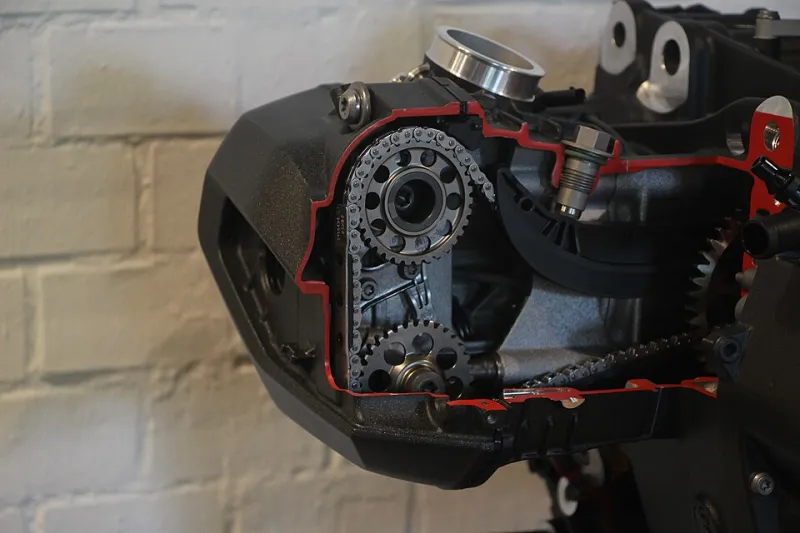
Photo: Wikisympathisant, CC BY-SA 4.0, via Wikimedia Commons
There's a specific kind of sick feeling that hits when your timing chain lets go at 7,000 RPM. One second you're pulling hard through third, the next you've got bent valves, a trashed head, and a motor that's basically scrap. It's not just expensive — it's the kind of failure that ends builds, ends seasons, and sometimes ends friendships when the blame starts flying.
What's happening more and more in underground circles is that these failures aren't random. They're predictable. And the people who've been around long enough are starting to connect the dots back to decisions made in engineering departments, not on the street.
The Factory Problem Nobody Wants to Talk About
OEM timing chain design has been in a slow decline for about two decades, and most mainstream automotive media won't touch the subject because it means calling out manufacturers by name. But in shops where people are actually pulling motors apart and studying what failed, the picture is pretty damning.
The core issue comes down to a few converging problems. First, automakers are designing timing systems for fuel economy and NVH — noise, vibration, harshness — not longevity under load. Thinner guides, lighter tensioners, and longer chain runs between sprockets all reduce rotating mass and quiet the valvetrain down. They also introduce flex, wear points, and failure modes that a stock engine running 25,000 miles a year might never see, but a built motor pushing 500 horsepower absolutely will.
Second, there's the oil pressure piece. Modern factory tensioners are hydraulically actuated, which means they're dependent on consistent oil pressure to maintain chain tension. Drop your oil level, run a high-performance oil pump that creates pressure spikes, or let the motor sit and bleed down between hard pulls — and that tensioner isn't doing its job. The chain gets slack. Slack becomes slap. Slap becomes catastrophic contact with the timing cover or a jumped tooth, and then you're shopping for a new block.
Third — and this is the one that really stings — a lot of OEM replacement parts are manufactured to the same spec as the originals. You're not buying a fix. You're buying a reset clock.
What the Underground Machine Shops Are Seeing
Talk to any shop that's been quietly building motors for the street scene for more than five years and they'll have a horror story reel. One builder we spoke with out of the Southeast, who asked to stay anonymous for obvious reasons, said he's pulled apart three different popular inline-four platforms in the last 18 months where the factory chain guides had essentially disintegrated — not worn, disintegrated — under sustained high-RPM use.
"The plastic they're using on some of these guides is fine for a commuter car," he said. "You put that under heat cycles and real power and it gets brittle. Then it cracks, and you've got plastic shrapnel floating around in your oiling system. It's not a matter of if. It's when."
Another builder working out of a private garage in the Midwest — the kind of place with no sign and a gate code — described the same pattern on a popular V6 platform that's become a sleeper staple in the underground. "Everyone wants to build these motors because the bottom end is strong. And it is. But the timing system is the weak link every single time. First thing I do now, before the motor even goes back together, is the whole timing system comes out and gets replaced with something that was actually engineered for abuse."
The Aftermarket Landscape: What's Worth It and What Isn't
Here's where it gets complicated, because the aftermarket timing chain market is not monolithic. There's genuine engineering improvement sitting next to rebadged OEM-spec garbage, and telling them apart takes some homework.
On the chain itself, the move that serious builders swear by is going to a double-roller setup where the application supports it. Double-roller chains distribute load across more contact points, resist stretch under high-tension conditions, and generally outlast single-row designs by a significant margin in high-performance applications. Brands like Cloyes and Melling have been manufacturing these for domestic V8 platforms for decades, and their reputation in the underground is solid — not because of marketing, but because motors built with their components keep coming back for power upgrades instead of emergency teardowns.
For import platforms, the calculus is a little different. The aftermarket is thinner, and some of what's out there is genuinely questionable. Builders who know what they're doing are often sourcing OEM-equivalent parts from Japanese domestic market suppliers rather than US-market replacements, because the quality control standards are different. It's more work to source, but the failure rate tells the story.
Tensioners are the other critical piece. Aftermarket billet tensioners — particularly those with adjustable spring tension or ratcheting mechanisms — give builders control that hydraulic OEM units simply don't. You can set the tension to match your oiling system and your RPM range instead of hoping the factory calibration works for a motor that's making twice its original power.
Guides are the unglamorous part of the conversation, but they matter. Steel-backed guides with nylon or UHMW-PE wear surfaces are the standard for any build that's going to see sustained high-RPM use. Straight plastic? It's a liability.
The Premium Parts Question
There's a persistent belief in some corners of the build scene that going OEM from the dealer — genuine factory parts, not aftermarket — solves the problem. It doesn't, and it's worth being direct about that. If the original engineering spec is the failure point, a genuine OEM replacement part built to the same spec is the same failure waiting to happen again. You're paying dealer markup for the privilege of doing the job twice.
That said, there are platforms where OEM-plus solutions exist — factory upgraded parts that came out of TSBs or running production changes that quietly addressed known failure modes. Identifying those requires knowing the production date ranges and part number revisions, which is the kind of information that lives in forums and shop knowledge, not on dealer websites.
The builders who are getting this right are treating the timing system as a consumable maintenance item on any serious build — something that gets inspected, measured for stretch and wear, and replaced on a schedule rather than run until failure. It costs more upfront. It costs a lot less than a hydrolocked cylinder head.
Building Trust in the Right Places
The underground has always run on shared knowledge, and the timing chain conversation is finally getting the attention it deserves in the right circles. Shops are talking, forums are documenting failure patterns, and builders who've been burned are passing on what they learned.
If your build is pushing serious power and you haven't looked hard at your timing system, that's the next conversation to have. Not with the dealer. With someone who's actually pulled one apart.