Factory Intervals Are a Racket: What OEM Timing Belt Schedules Are Actually Costing Your Build
There's a number printed somewhere in your owner's manual — 60,000 miles, maybe 90,000 if the manufacturer is feeling generous — and that number has a job to do. Not necessarily to protect your engine. To protect a revenue stream.
That's a provocative thing to say, and we're going to back it up. Because if you've spent any real time around high-mileage builds, performance motors, or the kind of underground engine builders who've torn apart hundreds of these systems over the years, you already know the truth: factory timing belt replacement intervals are, in most cases, padded. Sometimes significantly.
This isn't a fringe conspiracy theory circulating on obscure forums. It's a conversation happening in garages from Fresno to Fayetteville, and the people having it are sitting on decades of teardown data that the OEMs would rather you never see.
The Math Behind the Mandate
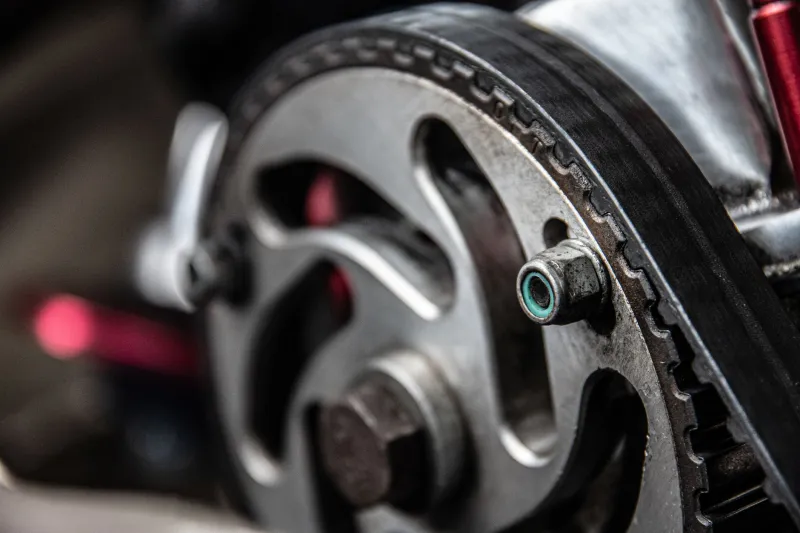
Timing belts fail in a few specific ways: tooth shear, core delamination, tensioner wear, and material hardening from heat cycling. Each of those failure modes has a measurable progression. They don't just happen at 60,000 miles because some engineer drew a line on a chart.
The actual elastomer compounds used in modern timing belts — HNBR (hydrogenated nitrile butadiene rubber) in most late-model applications — are dramatically more durable than the materials used when many of these service intervals were first established. Manufacturers updated the compounds. They didn't always update the intervals.
Why? Because a timing belt replacement is a labor-intensive job that dealers bill at a premium. On a lot of transverse-mounted interference engines — your EJ Subarus, your K-series Hondas before they went chain, your 2AZ Toyotas — a belt service can run $400 to $800 at a dealership. Multiply that across a national fleet and the math gets uncomfortable fast.
None of that means every belt is fine at 90,000 miles. It means the interval isn't derived purely from engineering necessity.
What Builders Are Actually Seeing at Teardown
Talk to any builder who regularly tears down high-mileage performance engines and you'll hear the same thing: belts pulled at factory-mandated intervals often look like they had another 20,000 to 40,000 miles of life left in them. Not always. But often enough to raise serious questions.
One engine builder out of the Southeast — running a shop that specializes in EJ and EZ Subaru builds — told us he's pulled belts at 90,000 miles that showed zero measurable tooth wear and no cracking in the backing material. Same guy has seen belts fail at 50,000 on a neglected motor running dirty oil and a failing tensioner bearing.
That's the real story. The belt isn't usually what kills the belt. The tensioner is. The idler pulley is. The water pump — which shares the belt drive on a lot of common platforms — is. Pull a belt at 60,000 miles and the belt is probably fine. Ignore a tensioner bearing that's been singing for 10,000 miles and you'll be pulling a bent valvetrain out of a freshly built motor.
The interval isn't the variable that matters most. The system condition is.
The Underground Approach to Interval Extension
So how are builders actually handling this? Not by ignoring maintenance — that's not the move. The smarter approach is condition-based inspection rather than mileage-based replacement.
Here's what that looks like in practice:
Visual and tactile inspection at every oil change. If your build has an accessible timing cover inspection port — and a lot of them do — you pull the cap, hit it with a flashlight, and look. Cracking on the belt backing, glazing on the teeth, any sign of fraying or uneven wear on the edges: those are your pull triggers. Mileage is secondary.
Tensioner bearing replacement on a tighter schedule than the belt itself. This is where builders are actually saving engines. A quality aftermarket tensioner — Gates, Dayco, or a platform-specific upgrade from a reputable supplier — goes in every 50,000 to 60,000 miles regardless of belt condition. The belt might be fine at 100,000. The tensioner bearing has no business being there that long under performance loads.
Oil contamination monitoring. Valve cover leaks and front main seal seepage are belt killers. Oil-contaminated belts degrade at an accelerated rate that makes any mileage interval meaningless. Builders who keep their engines clean and leak-free are operating in a completely different wear environment than a neglected stock motor.
Thermal management. Heat cycling is the silent enemy. Builds running elevated coolant temps — anything consistently above 210°F — are degrading belt compounds faster than the factory's test data accounts for. If your cooling system is dialed and your thermostat is doing its job, you're running in a better environment than a lot of factory test scenarios assumed.
Aftermarket Belts and the Interval Question
The aftermarket has responded to this conversation with some legitimately interesting products. Gates Racing, for example, produces high-performance timing belts using reinforced aramid fiber cores and upgraded tooth profiles specifically designed for modified applications running higher RPM loads. These aren't just rebranded OEM parts — the construction is meaningfully different.
The honest answer on interval extension with these belts: it depends on the application. On a naturally aspirated build running moderate RPM, a quality aftermarket belt with a rigorous inspection protocol can reasonably push past OEM intervals. On a turbocharged build running elevated boost and regular high-RPM pulls, you're adding stress the factory interval never accounted for in either direction — which means the OEM schedule might actually be more appropriate, not less.
Context matters. The interval isn't a universal truth. It's a starting point for a conversation about your specific build, your specific use case, and how well you're maintaining the supporting hardware around the belt itself.
The Bigger Picture
The timing belt replacement schedule is a small piece of a larger pattern worth paying attention to. OEM service intervals across the board — from transmission fluid to differential oil to coolant — are frequently set in ways that benefit dealer service departments more than they benefit your engine.
Underground builders have always operated from a different baseline: understand the actual failure mechanism, monitor the actual system condition, and replace components when the evidence says to — not when the manual says to because someone in a corporate office decided that was the number.
That approach requires more attention and more knowledge. It also produces engines that live longer, get maintained smarter, and don't get pulled apart on someone else's schedule.
Your timing belt isn't a subscription service. Treat it like the mechanical system it actually is.