Spec Sheet Sabotage: How Factory Valvetrain Data Is Quietly Killing Your Power Numbers
You dropped real money on this build. Upgraded injectors, a proper intercooler, a tune from someone who actually knows what they're doing. You strapped it to the dyno expecting a number that would make people uncomfortable at stoplights. Instead, you got something close to what a stock car makes with a good air filter. Frustrating doesn't cover it.
Here's what a lot of builders in the underground are starting to figure out: the ceiling on a lot of popular platform swaps isn't the turbo, the fuel system, or even the tune. It's the valvetrain. Specifically, it's the assumption that factory cam profiles and valve spring rates are good enough to support serious power once everything else gets upgraded. Spoiler—they usually aren't.
The Problem Nobody Puts on the Parts List
When you're building off a popular swap platform—an LS into a Miata, a K-series into a CRX, a 2JZ into basically anything with four wheels—you're working from a recipe that's been passed around forums and group chats for years. That recipe usually covers the headline stuff: engine mounts, oil lines, cooling, maybe a standalone ECU. What it almost never covers in detail is valvetrain compatibility.
Factory cam profiles are designed around a specific RPM range, a specific compression ratio, and a specific power target. That target is almost always modest, because automakers are balancing fuel economy, emissions compliance, and warranty costs, not quarter-mile times. When you start stacking upgrades on top of that foundation, you can quickly outrun what the factory valvetrain was ever designed to handle.
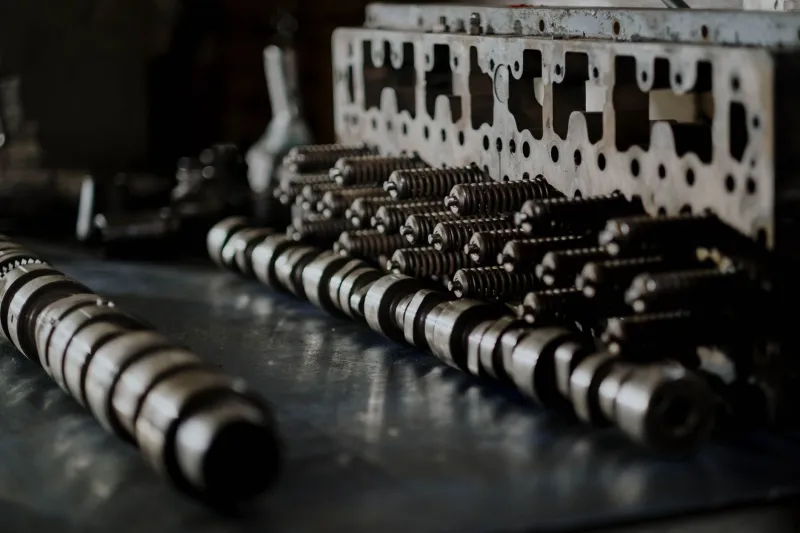
The cam profile dictates when the valves open, how far they open, and how long they stay open. Get that timing wrong relative to your other modifications—especially forced induction—and you're either leaving power on the table or, worse, creating conditions that can bend valves or float them at high RPM. Neither outcome is cheap.
Spring Rates and the Redline Wall
Valve float is one of those failure modes that's hard to diagnose if you don't know what you're looking for. The engine feels strong down low, pulls reasonably well through the midrange, and then just... stops making power as you approach the top of the rev range. A lot of builders chalk it up to fuel delivery or tune issues and start chasing ghosts.
What's actually happening in a lot of those cases is the valve springs can't keep up. Factory spring rates are matched to factory cam lift and RPM expectations. Upgrade the cam without upgrading the springs—or worse, run a cam with higher lift than the springs were designed for—and the valves start bouncing at high RPM instead of following the cam lobe cleanly. The engine doesn't blow up immediately, but it doesn't make the power it should, and over time you're accelerating wear on the cam lobes, the followers, and the valve seats.
A builder in the Atlanta scene running a built K24 in a first-gen Civic ran into exactly this problem. He'd gone through two tunes and replaced his fuel pump chasing a power plateau before someone finally suggested pulling the valve cover and checking spring pressures. The springs were original Honda units, running against an aftermarket cam with significantly more lift than stock. The springs were coil-binding at high lift. Every pull above 7,500 RPM was essentially a waste of fuel.
New springs, a proper retainer and keeper setup, and a re-tune later, he picked up 28 wheel horsepower without touching anything else. That's not a rounding error.
Rocker Geometry: The Part of the Equation Everyone Ignores
If valve springs are the part people sometimes forget, rocker arm geometry is the part almost nobody thinks about until something breaks. On pushrod engines especially—your LS family, your small-block Chevy variants—rocker geometry has a massive effect on how cleanly the valve opens and closes, and how much side-loading gets put on the valve stem in the process.
When you change cam lift, you often need to revisit pushrod length to maintain proper rocker arm geometry at mid-lift. Run pushrods that are too short or too long for your new cam, and the contact patch between the rocker tip and the valve stem tip walks across the stem instead of staying centered. That means uneven wear, increased friction, and a valvetrain that's fighting itself every time the engine fires.
Some builders spend serious money on roller rocker arms—which do reduce friction and can handle more aggressive cam profiles—but install them without checking pushrod length and end up with worse geometry than stock. The part upgrade becomes a net negative because the geometry was never dialed in.
Proper pushrod length checking is a tedious process. You use a checking pushrod, degree the cam, and measure contact patterns with layout dye on the valve stem. It's not glamorous work, but builders who skip it and then wonder why their expensive rocker upgrade didn't show up on the dyno are getting exactly what they paid for.
Custom Valvetrain Engineering Is No Longer Just for Race Teams
The underground's response to all of this has been a slow but real shift toward treating the valvetrain as a system to be engineered, not a collection of individual parts to be upgraded in isolation. Cam grinders who used to work almost exclusively with professional race shops are now fielding calls from street builders who want custom grinds matched to their specific combination—not a shelf cam designed for a generic application.
That conversation, the one between a builder and a cam grinder, used to be intimidating and expensive enough that most people avoided it. That's changing. The information is more accessible than it used to be, the community is more willing to share what they've learned, and builders who've been burned by the generic bolt-on approach are motivated to do it right the next time.
Custom work costs more upfront. A shelf cam might run you $300 to $500 for a popular application. A custom grind, with the right spring package and geometry check built into the process, might run two to three times that. But if the alternative is spending $2,000 on other upgrades and a tune that never delivers because the valvetrain is the actual bottleneck, the math starts looking different.
Stop Blaming the Tune
The underground has a tendency to treat the tune as the solution to every power problem. Bad numbers? Tune it harder. Plateau you can't break through? Get a better tuner. And while tuning is genuinely critical, it can only work with what the hardware allows. A great tune on a valvetrain that's working against itself is still going to leave power behind.
If your build has stalled at a number that doesn't make sense given your parts list, start asking questions about the valvetrain before you buy anything else. Pull the valve cover. Check your spring pressures. Verify your pushrod length. Look at your cam card and actually compare the specs to what your combination needs.
The parts you can't see are often the ones doing the most damage to your numbers. The builders who understand that are the ones posting dyno sheets worth talking about.