Dead Pedal: How Chasing Power Without Upgrading Your Brakes Turns Builds Into Rolling Disasters
Every builder knows the feeling. You've spent months stacking power. New turbo, forged internals, a tune that makes the dyno operator raise an eyebrow. The car hooks hard, pulls clean through every gear, and then—somewhere between third and fourth, deep into a run—the pedal goes soft. You push harder. Nothing. The car is still moving, still carrying speed, and the brakes have basically clocked out for the night.
That's brake fade. And it's happening more often than anyone in the underground wants to admit.
"People obsess over making power and then just assume the brakes will handle it," says a builder out of the Atlanta area who goes by Sully and has been turning wrenches on street builds for over a decade. "They'll spend eight grand on a turbo kit and then complain when I tell them they need to budget another two for the brake system. Like stopping the car is optional."
It's not optional. But the way the scene is built—always chasing the next horsepower milestone—brake upgrades often end up being an afterthought. That gap between what the motor can do and what the brakes can handle is where things go sideways. Sometimes literally.
Why Factory Brakes Were Never Built for This
Here's the thing about factory brake systems: they're engineered to match the car as it left the plant. OEM engineers spec rotors, calipers, pads, and fluid to handle the weight, speed, and power the vehicle was designed to produce. The moment you start adding serious horsepower, you're operating outside that design envelope.
Brake fade comes in two main flavors, and both are bad news on a high-power build.
Fluid fade happens when brake fluid absorbs heat—either from aggressive use or from heat migrating through the caliper—and starts to boil. Boiling fluid creates vapor, and vapor compresses. Suddenly your hydraulic system, which depends on an incompressible fluid to transfer pedal force to the caliper, has a pocket of gas in it. The pedal goes long. You push and push and get almost nothing back.
Pad fade is a different animal. When brake pads overheat beyond their rated temperature range, the binding resins that hold the friction material together start to outgas. That layer of gas between the pad face and the rotor acts like a lubricant—the exact opposite of what you want. Friction drops, stopping distances climb, and if you're running hard at the end of a straight, you've got a problem.
Factory DOT 3 fluid—what a lot of stock vehicles run—has a dry boiling point around 400°F. Sounds like a lot until you realize aggressive braking on a heavy, fast car can push caliper temps well past that in just a few hard stops. DOT 4 pushes that number up, and racing-spec fluids like Motul RBF 660 or Castrol SRF can handle 600°F and beyond. That's not overkill for a built street car. That's basic math.
The Rotor Problem Nobody Wants to Talk About
"Stock rotors are just not built for repeated thermal cycling at the temperatures we're generating," says Marcus, a fabricator in Houston who builds dedicated street/strip cars out of a shop that doesn't advertise on Google. "You push a factory rotor hard enough, enough times, it glazes, it cracks, it warps. And a warped rotor on a car making 600 horsepower is a nightmare scenario."
The underground has largely moved toward two-piece floating rotors for serious builds—an aluminum hat mated to a steel or iron rotor ring. The floating design allows the rotor to expand thermally without transferring stress to the hat or the hub, which reduces warping and cracking. It also drops unsprung weight, which helps the suspension do its job.
Slotted and drilled rotors are everywhere in the scene, but there's a real conversation to be had about which is appropriate for which application. Drilled rotors shed heat and gas well but can crack under repeated extreme stress—they're better suited for lighter cars or track-day use where the heat cycles are controlled. Slotted rotors are more durable under punishment and do a good job of sweeping debris and gas from the pad surface. For a hard street car that sees aggressive use, slots are usually the smarter call.
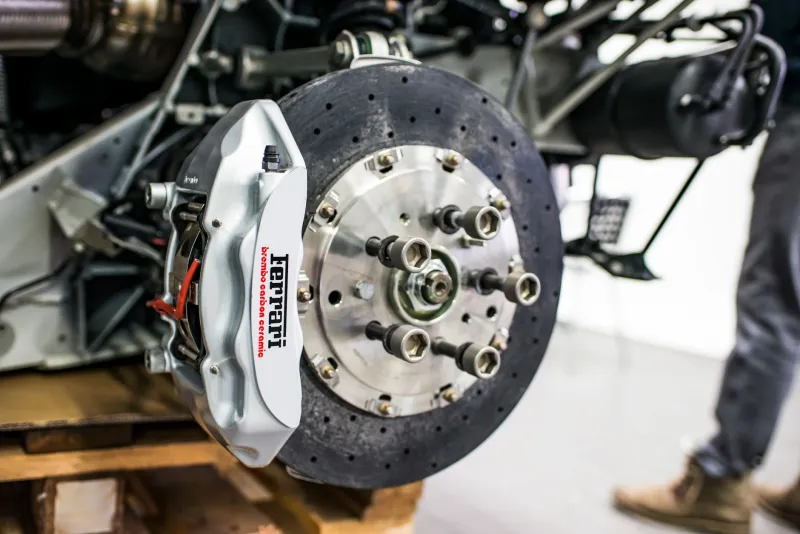
Carbon-ceramic rotors are out there, and they're genuinely impressive in terms of heat resistance and weight savings, but the cost is still prohibitive for most underground builders. A full set for a performance application can run $5,000 or more. The conversation usually ends there.
Pads, Compounds, and the Matching Game
Pad selection is where a lot of builders get caught out. High-performance pads have operating temperature windows—they need to be in a certain heat range to work properly. Run them cold and they don't bite. Push them past their ceiling and you're back to fade territory.
Street pads are formulated to work from a cold stop, which is what you need for daily driving. But put a street pad on a car making serious power and drive it hard, and you'll cook it. Track-oriented compounds like Hawk DTC-60 or Ferodo DS2500 are designed to handle higher sustained temps, but they can be grabby and noisy when they're cold—which matters when you're driving the car to the spot before you run it.
The solution most serious builders land on is a high-quality performance street compound—something like EBC Yellowstuff or Hawk HPS 5.0—that bridges the gap. These compounds handle elevated temps better than stock but still work reasonably well at street temperatures. It's a compromise, but it's a livable one.
"You have to be honest about what the car is," Sully says. "If it's a dedicated strip car that goes on a trailer, you can run full race pads and not worry about cold bite. If it's a street car that has to drive forty miles to get to the spot, you need something that works in the real world."
Caliper Upgrades and the Big Brake Conversation
Bigger calipers with more pistons generate more clamping force and distribute heat more evenly across the pad surface. For builds pushing serious power, a big brake kit is often the right call—not just because of the performance gain, but because larger rotors carry more thermal mass, which means they absorb and dissipate heat more effectively before fade sets in.
Brands like Wilwood and StopTech have become staples in the underground scene for exactly this reason. They offer application-specific kits that fit inside common wheel sizes, and their components are designed from the ground up for high-performance use rather than being adapted from OEM parts. The price point is real—a full Wilwood kit can run $1,500 to $3,000 depending on the application—but compared to what's at stake when your brakes give up at speed, it's not a hard argument to make.
Stop Treating Brakes Like an Afterthought
The underground runs on horsepower culture. That's not changing. But the builds that last, the ones that run consistently and don't end up wrapped around something or impounded because of an incident, are the ones where the builder thought about the whole system.
Power without stopping ability isn't a performance build. It's a liability. The physics don't care how good your tune is. If you can't scrub speed when you need to, all that horsepower becomes a problem you can't outrun.
Upgrade your fluid. Match your pads to your use case. Think seriously about your rotor choice and whether your calipers are up to the job. And if someone tells you your brake budget should be zero because the factory stuff is fine—find a different builder.
The finish line means nothing if you can't stop before the wall.