Ears Before Equipment: What Your Engine Is Telling You Before the Dyno Gets a Chance to Lie
Walk into any serious underground shop and you'll find guys who've been building and tuning cars longer than most tuning software has existed. Ask them how they know when something's wrong, and they'll probably tap the side of their head before they ever point at a laptop. There's a whole language buried inside a running engine — a vocabulary of knocks, ticks, hisses, and harmonics that tells the story of what's really happening inside the block. Learning to read that language isn't just old-school charm. For builders pushing serious power on the street, it might be the only early warning system that actually works.
Why Digital Tools Miss What Your Ears Catch First
Here's the uncomfortable truth nobody in the tuning software business wants to advertise: data logging and dyno pulls are both lagging indicators. By the time a knock sensor throws a flag or a wideband AFR reading dips somewhere ugly, the damage is often already in motion. Bearings don't announce themselves on a graph until they're already spinning loose. Pre-ignition events don't always register cleanly on a knock sensor that's been calibrated for a stock application. A small boost leak doesn't always tank your numbers enough to show up clearly on a single pull.
But your ears? Your ears catch that stuff in real time, with zero latency.
Experienced builders aren't abandoning their data — they're using sound as a first-pass filter that tells them where to point the instruments. Think of it less like replacing technology and more like having a scout out ahead of the main force.
The Sound Map: What Each Noise Actually Means
Detonation and Pre-Ignition
Detonation has a specific character that separates it from normal combustion noise — a sharp, metallic rattle that tends to show up under load, especially at mid-range RPM when cylinder pressure is climbing hard. Old-school builders sometimes call it "pinging," but on a built motor running boost, it sounds more like someone briefly dragging a handful of gravel across a tin roof. It's fast, it's harsh, and it sits on top of the engine's normal frequency in a way that's distinctly uncomfortable once you've heard it a few times.
Pre-ignition is a different animal and arguably scarier. It tends to produce a deeper, heavier knock that doesn't necessarily correlate with throttle input the way detonation does. You might hear it on deceleration, or at idle, which makes it confusing for builders who expect knock to only happen under load. If you're hearing something heavy and low-frequency that doesn't follow the rev cycle the way you'd expect, don't wait for the knock sensor to confirm it.
Bearing Wear
Main and rod bearing noise is one of those things that, once you've heard it, you never forget. Rod knock specifically produces a rhythmic, hollow clatter — sometimes described as a light hammering sound — that tends to be load-sensitive and RPM-proportional. It gets louder as you apply throttle and backs off slightly when you lift. On a cold start it might be subtle enough to dismiss, but as oil pressure stabilizes and the engine warms up, a bad rod bearing will usually make itself impossible to ignore.
Main bearing noise sits lower in the frequency range and tends to be less rhythmic, more of a thudding undertone. Either way, if you're hearing any kind of rhythmic mechanical noise that tracks with engine speed, you're probably past the "let's log a few more pulls" stage.
Valvetrain Chatter
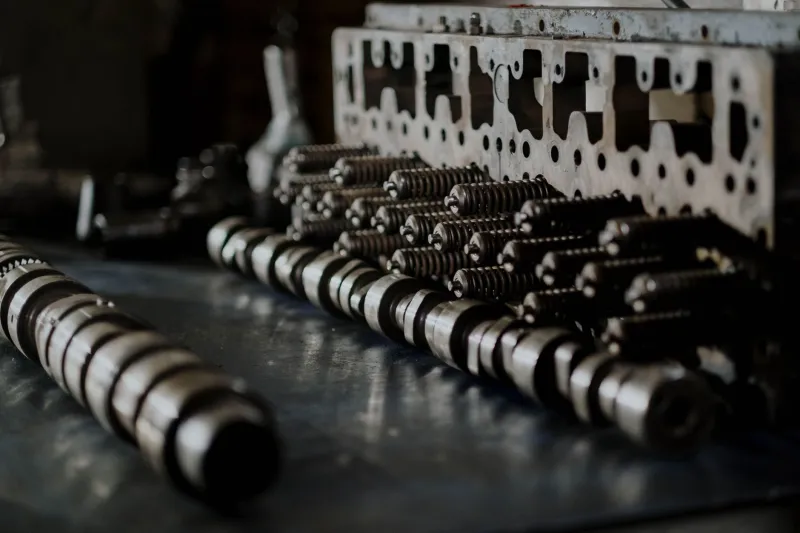
Valvetrain noise on a built motor is its own diagnostic category. Aggressive cam profiles, stiff springs, and high-RPM operation all generate more mechanical noise than a stock setup, so the baseline is already elevated. The key is learning what your specific valvetrain sounds like when it's healthy — that way, when something changes, you notice.
A loose rocker or a collapsed lifter tends to produce a rapid, high-frequency ticking that's distinctly different from normal valvetrain operation. It's often most pronounced at idle and may quiet down at higher RPM as oil pressure increases, which is part of why it gets ignored. Builders who only listen to their car under load miss a lot of what idle and low-RPM operation is trying to tell them.
Broken or cracked valve springs produce a more irregular clatter — less rhythmic than bearing noise, more chaotic. On a high-strung motor with aggressive spring pressures, a broken spring can escalate from a rattle to a catastrophic event fast enough that your data logger never gets the chance to record it cleanly.
Boost Leaks
Boost leaks are sneaky because they don't always tank your numbers dramatically on a single pull. A small crack in an intercooler coupler or a slightly loose clamp might only cost you a few pounds of boost — not enough to make your dyno sheet look obviously wrong, but enough to flatten your power curve in ways that are easy to misattribute to fueling or timing.
Auditorially, boost leaks have a pretty distinctive signature: a high-pitched hiss or whistle that appears under boost and disappears when you're off throttle. Some leaks are louder than others depending on location and size, but the key characteristic is that they're load-dependent. If you're hearing a hiss that tracks with boost pressure, start squeezing couplers and checking clamps before you start chasing a tune.
Building the Skill: How to Actually Develop Sound Literacy
This isn't something you learn from a YouTube video. Sound diagnostics is a craft built on repetition and reference points. The builders who are best at it have logged thousands of hours under hoods, across different platforms, listening to engines in varying states of health and distress.
The practical path for most builders starts with learning what their specific engine sounds like when everything is right. Before you start chasing power, spend time listening to the car at idle, under light load, at WOT, on deceleration. Build a mental baseline. Record it if you have to — there are cheap clip-on microphones that can capture engine bay audio clearly enough to compare sessions.
From there, it's about exposure. Spend time around other builds. Listen to engines that are known to have issues. Talk to older builders who've been doing this since before data logging was accessible. The knowledge base exists — it's just not packaged in an app.
The Bigger Picture
Underground build culture has always operated at the intersection of instinct and information. The builders who last — the ones who don't blow motors at the worst possible moment — are the ones who've learned to trust what they hear as much as what they see on a screen. Digital tuning tools are powerful, but they work best when the person using them already has a strong read on what the engine is doing mechanically.
Your dyno sheet tells you what happened. Your ears tell you what's about to. In this game, that lead time is everything.