Downforce Isn't a Sticker: What Street Cars Actually Do With Aero
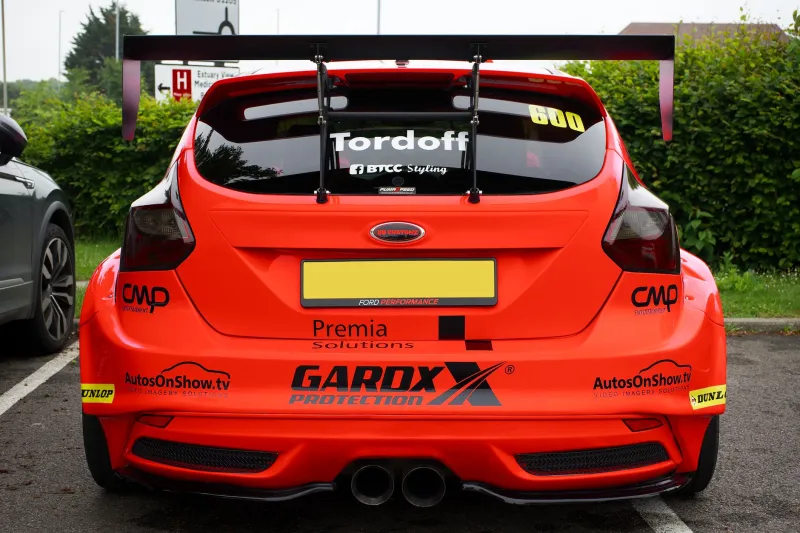
Ask ten people in a parking lot what their wing does and you'll get ten answers, most of them wrong. Ask what it did to their highway fuel economy, their front-end feel at 90 mph, or their lap times, and the conversation gets quiet fast. Aero is the last unexplored frontier of the street build for a simple reason: it's the only modification that changes how the car behaves without changing anything you can hear, smell, or feel in the driver's seat at 35 mph.
That silence is the trap.
Downforce Is a Speed Problem Before It's a Parts Problem
Here's the math that ends most aero arguments before they start. Aero forces scale with the square of velocity. Double your speed and you quadruple the load. Triple it and you're at nine times. A splitter making 15 pounds of downforce at a 30 mph crawl is making somewhere north of 150 pounds at 100 mph, and over 400 at 160.
Which means most of the aero hardware bolted to street cars is doing approximately nothing at the speeds those cars actually see — while still adding weight, drag, and a sacrificial lip for every driveway in your zip code. That's not an argument against aero. It's an argument for knowing which speed band you're buying for. A car that commutes at 40 and pulls one on-ramp a day is buying a look. A car that sees triple-digit pulls, canyon runs, or track nights is buying grip, and you can absolutely feel the difference. Just be honest about which one you signed up for.
The Part Nobody Brags About: Drag
Downforce is never free. It's paid for in drag, and drag scales with the square of speed too. A wing at full angle on a street car will cost you top-end pull, fuel mileage, and — on more cars than anyone admits — airflow to the intercooler and radiator you spent real money keeping cool. The scene has spent a decade chasing cooling, then bolted a parachute to the decklid.
The rule that comes out of every wind tunnel sheet: the best aero part is usually the one that removes a bad shape rather than adding a new one. A sealed undertray, a flat and closed-off front end, a properly vented hood — those give you stability without turning the car into a brick.
Splitters: The Upgrade That Actually Works
A front splitter is the most underrated piece in the aftermarket. It creates a high-pressure zone above and a low-pressure zone below, and it needs three things to do anything at all: rigidity, proximity to the ground (typically 2 to 4 inches), and something behind it — a flat or sealed underbody.
Which is why the scene's favorite builds — zip-tied ABS plastic, aluminum composite, or a genuinely well-made carbon piece — work on some cars and fall apart on others. A splitter hanging off the factory plastic bumper with no underbody behind it is a wingtip fence for a plane that doesn't exist. And lawn edging at 90 mph doesn't flex, it flutters, cracks, and occasionally leaves the car.
Rigidity matters more than material. A floppy splitter is a drag device and a fatigue failure waiting to happen.
Diffusers Beat Wings on Most Street Cars
A rear diffuser expands air coming out from under the car, drops its pressure, and pulls the car down without the drag penalty of a wing. On paper it's the smarter of the two for a street-driven build. In practice it's hypersensitive to rake and ride height. Too high off the ground and it does nothing. Too low, or with too much rake dialed in, and it can stall and start producing lift instead.
That's the reason a $200 eBay diffuser on a car with a 4-inch drop and 2 degrees of rake does less than nothing. It's not that the part is fake. It's that it's being asked to work outside its window.
Wing Angle Is a Stability Question, Not a Style Question
Adding rear downforce without front downforce shifts aero balance rearward. The front gets light at speed, steering goes vague, and braking gets genuinely sketchy. That's the classic high-speed float complaint, and it almost never gets blamed on the wing that caused it.
Most street cars need somewhere between zero and five degrees of wing angle — not all the way up. And you need to check the angle with weight in the car and the suspension loaded, because brake dive changes the aero platform and pitched-forward cars behave differently than level ones.
Test It Instead of Arguing About It
The builders getting this right are the ones treating aero like a tuning problem, not a styling decision. Their toolkit is unglamorous:
- Coast-down testing on the same stretch of flat road, same day, same tire pressures, measuring time between two GPS speed points
- Tire temperature deltas across the tread with an IR gun or pyrometer after a hard pull
- Ride height logging at speed (string potentiometers or a cheap GPS-based setup)
- Tuft and string testing filmed on a phone to see where air is actually going
- Phone accelerometers for cornering grip before and after a single change
One change at a time. Same road. Same weather. Written down. That's it. That's the whole secret.
The Driveway Tax
Street cars pay for aero in ways track cars don't. Scraped splitter lips. Cracked end plates from curb stops. Parking garages that turn a good day bad. A car that makes real downforce at 110 mph often has to be driven up ramps at 2 mph to survive a Tuesday.
And once a splitter cracks, most people leave it on. A flapping, half-attached aero part at speed is worse than no aero part at all.
The Bottom Line
Aero on a street car is worth doing — but do it in this order: close the holes in the front end, seal the underbody, add a modest and rigid splitter, get the rake right, then consider a diffuser. Add the wing last, and add it with restraint. Measure every step. If you can't describe what a part did in numbers, you don't know what it did. You just like how it looks — which is fine, as long as you're not telling anyone it made the car faster.