Five Engine Swaps That Turn Grocery-Getter Sleepers Into Supercar Killers
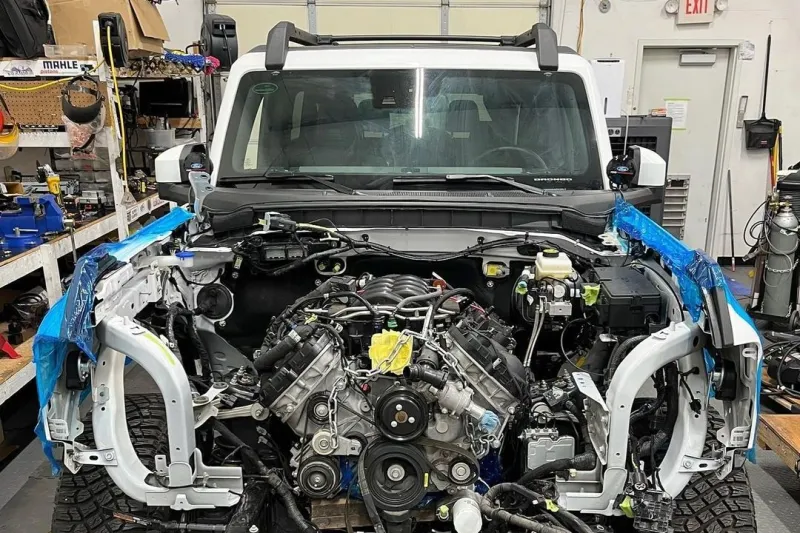
Photo: engine swap fabrication garage V8 swap performance build, via static0.carbuzzimages.com
When the Shell Lies and the Engine Tells the Truth
There's a particular kind of satisfaction that lives inside a sleeper build. You pull up to a light in something that looks like it should be parked outside a community college, and when the moment comes, you simply disappear. The driver of the Porsche next to you doesn't know what happened. You do.
Engine swaps are the backbone of that philosophy. Dropping a massively capable powerplant into a platform that was never meant to carry it — and making it work — is equal parts mechanical artistry and stubborn determination. It's also one of the most technically demanding things you can do in a garage, and the gap between a clean build and an expensive disaster often comes down to preparation, research, and knowing which combinations actually make sense.
We pulled together five of the most proven, most capable, and most satisfying engine swap pairings in the US performance scene right now. These aren't theoretical — they're builds that real people have executed, and in many cases, are driving every day.
1. LS V8 Into a Honda Civic (The Classic Chaos Build)
Why It Works: The LS family of engines — particularly the LS1, LS3, and LS6 — is the American small-block reimagined for the modern era. Lightweight aluminum construction, massive displacement, and an aftermarket ecosystem so large it's almost absurd. Dropping one into a Civic EG or EK shell creates something that defies physics on paper and delivers on the street.
The Fabrication Reality: This is not a weekend job. You're looking at a full custom subframe or a fabricated engine mount kit (companies like Hasport and swap-specific fab shops have made this more accessible), a modified firewall in most cases, and a complete drivetrain rethink. The Civic's stock transmission won't survive this conversation — most builders run a T56 Magnum or a Tremec TKX mated to a custom driveshaft. Rear end upgrades are mandatory; the factory setup will grenade on the first hard launch.
Tuning Requirements: With a standalone ECU like a Holley Terminator X or a Speartech harness conversion, getting the LS running cleanly is achievable for a competent tuner. Plan for a chassis dyno session and budget for it.
Real Numbers: A well-built naturally aspirated LS3 Civic will put 380-420whp through the rear wheels. Bolt on a ProCharger or a single turbo setup and you're looking at 600+ on pump gas. Sub-11 second quarter miles in a car that weighs under 2,500 pounds.
Cost Estimate: $12,000–$22,000 all-in depending on labor, engine condition, and how deep you go on supporting mods.
Builder note from a California-based fabricator who's completed four of these builds: "The hardest part isn't the engine. It's the cooling. You're asking a radiator designed for a four-cylinder to manage a V8 under load. You have to rethink the whole front end."
2. 2JZ-GTE Into a BMW E46 (The Import-Euro Crossover)
Why It Works: Toyota's legendary inline-six has powered some of the most iconic builds in global tuning history. The 2JZ-GTE, pulled from the Supra TT, is famous for its cast-iron block that handles absurd power levels on stock internals. Dropping it into an E46 chassis gives you a near-perfect weight distribution platform with European suspension geometry and one of the most tuneable engines ever built.
The Fabrication Reality: Swap kits from companies like Sikky Manufacturing and LSx Innovations have made this significantly more approachable, but "more approachable" is relative. You'll need custom motor mounts, a transmission tunnel modification for the R154 or Getrag gearbox, and a wiring harness conversion. The E46's factory electronics and the 2JZ's Toyota brain need to coexist, which means either a full standalone setup or a competent conversion harness.
Tuning Requirements: The 2JZ loves boost. A single 6266-style turbo on a proper manifold with supporting fuel system upgrades — bigger injectors, upgraded fuel pump, flex fuel capability if you're going big — is the standard recipe. A Haltech or AEM Infinity standalone ECU gives you full control.
Real Numbers: A street-friendly 600whp 2JZ E46 is genuinely achievable. Push the boost and upgrade internals and you're in 800-1000whp territory on E85. Quarter mile times in the low 10s from a car that rides and handles like a sport sedan.
Cost Estimate: $15,000–$30,000 depending heavily on turbo configuration and whether you source a used 2JZ or build fresh.
3. Coyote 5.0 Into a Fox-Body Mustang (The Factory Logic Build)
Why It Works: Ford actually sells a crate version of this swap, which tells you everything. The Gen 2 Coyote 5.0 — producing 460 horsepower stock — slotting into a Fox-body Mustang that originally came with a carbureted 5.0 is the automotive equivalent of a software upgrade. The platform was designed around this engine family, and the weight difference between the old pushrod mill and the new modular is minimal.
The Fabrication Reality: Easier than anything else on this list, but still not trivial. Motor mount adapters, a control pack or standalone ECU, and upgraded fuel delivery are the baseline. Transmission compatibility is relatively straightforward — the T56 or a Ford Performance TR3650 bolts in with minimal drama. Cooling and exhaust routing are the biggest headaches.
Tuning Requirements: Ford Performance sells a complete control pack that makes the Coyote run without the factory BCM and security system — it's one of the cleanest solutions in the swap world. Tune it on a Dynojet and you're done.
Real Numbers: 420-440whp at the wheels in naturally aspirated form. Add a Whipple or Roush supercharger and 600-700whp is streetable. Fox bodies weigh around 3,100 pounds, so the power-to-weight math gets violent quickly.
Cost Estimate: $8,000–$18,000. The most cost-effective swap on this list given the parts availability and factory support.
4. RB26DETT Into a 240SX (The JDM Legend Treatment)
Why It Works: Nissan's RB26 — the engine that powered the legendary Skyline GT-R — is a twin-turbocharged inline-six that produces factory numbers north of 276 horsepower (wink) and responds to modification like few engines in history. The S13 and S14 240SX chassis is already a beloved drift and performance platform. The combination is almost poetic.
The Fabrication Reality: Sourcing an RB26 in the US requires either importing from Japan (legal under 25-year import rules for older examples) or finding a used unit stateside — both have gotten more expensive. Engine mounts, transmission tunnel work for the RB's length, and driveshaft fabrication are required. This is a more involved swap than the Fox-body Coyote by a significant margin.
Tuning Requirements: The factory twin-turbos can be retained or replaced with a single large-frame turbo for more top-end power. The RB26 responds extremely well to single-turbo conversions. A standalone ECU is essential — Link G4X or Haltech Elite are popular choices.
Real Numbers: 500-600whp on a single turbo conversion with supporting mods is a well-documented result. The 240SX's light weight — around 2,600 pounds — makes this combination genuinely terrifying.
Cost Estimate: $18,000–$35,000. RB26 prices have climbed sharply with collector demand.
5. Hellcat 6.2 Supercharged HEMI Into a Classic Muscle Car (The American Excess Build)
Why It Works: 707 horsepower. From the factory. In a crate engine that Dodge sells directly. Dropping a Hellcat 6.2 supercharged HEMI into a first-gen Challenger, Barracuda, or B-body Dodge is the most American thing you can do with a garage and a credit card.
The Fabrication Reality: The Hellcat engine requires the factory Dodge control module and a full wiring harness conversion. Companies like Speartech have developed plug-and-play solutions. Engine mounts, transmission compatibility (the factory 8HP90 automatic is the path of least resistance), and serious brake and suspension upgrades are non-negotiable at this power level.
Tuning Requirements: The Hellcat's factory tune is already aggressive. Most builders leave the ECU largely stock and focus on supporting systems — fuel, cooling, and driveline strength.
Real Numbers: 650-680whp at the wheels in a car that weighs 3,400 pounds. Low 10-second quarter miles with drag radials. Mid-9s with a proper suspension setup and slicks.
Cost Estimate: $20,000–$40,000. The engine crate alone runs $20,000 through Mopar Performance. But you're buying factory reliability in a package that will embarrass almost anything on the street.
The Bottom Line on Swaps
Every build on this list has one thing in common: the gap between a clean execution and an expensive pile of problems is information. Research your specific chassis, connect with builders who've done the exact combination you're targeting, and budget for the unexpected — because in fabrication, the unexpected is basically scheduled.
The payoff, though, is real. There's nothing in the automotive world quite like building something that nobody sees coming.